
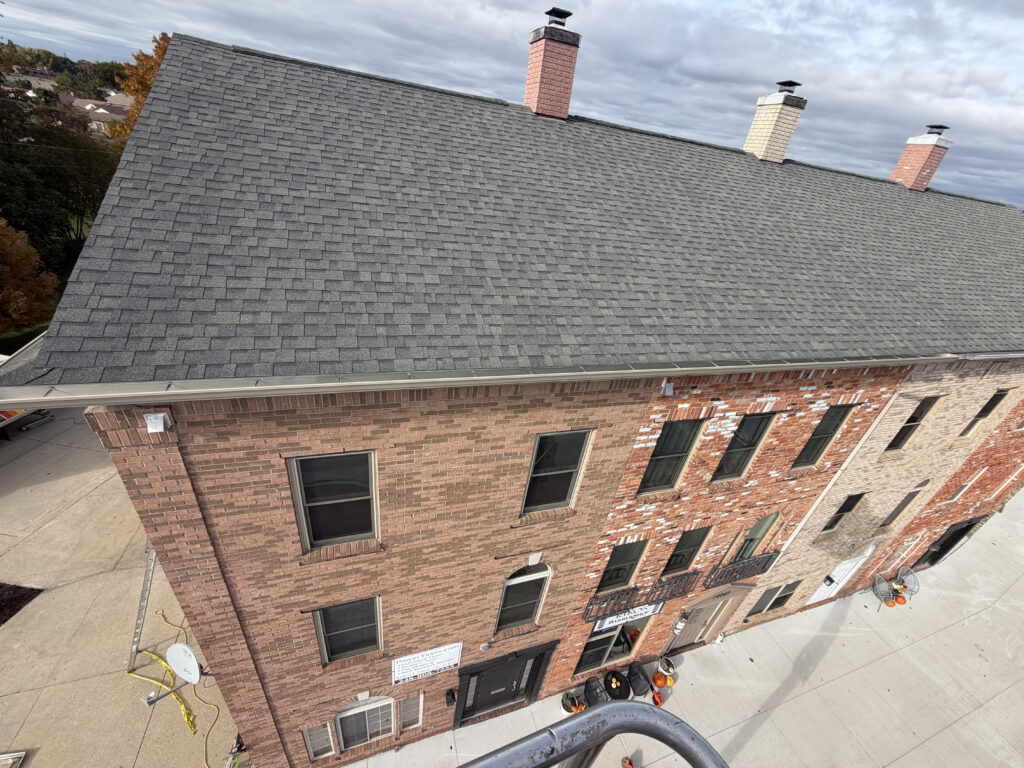

Two Macomb County homes can have almost identical floor plans—and very different roof replacement estimates. One roof might have steep slopes, several valleys, worn flashing, and damaged decking. The other could be a straightforward ranch roof. Even with the same shingles, those are two very different jobs.
If you’re researching roof replacement cost in Macomb County, MI, you want a number you can trust before inviting contractors to your home. A 2026 contractor pricing guide puts a typical installed asphalt-shingle replacement at roughly $9,000–$18,000. That’s a starting point, not a countywide average or a True North Home Solutions price list. Your roof could cost less—or more. The important question is why.
Here’s a detail that catches people off guard: roofers measure in “squares.” And one roofing square means 100 square feet of roof surface, not 100 square feet of living space. Roof pitch, garages, overhangs, and layout all affect how much material and labor the job requires.
We’ll walk through roof sizes, material choices, tear-off, flashing, ventilation, and the problems you might not see until the old shingles come off. You’ll also learn how to compare written estimates, ask about permits, and decide whether a repair is worth considering before committing to a new roof.
The goal isn’t to memorize a price range. It’s to understand what you’re buying. Start with the numbers—and what’s actually behind them.
What Is the Average Roof Replacement Cost in Macomb County?
For a full asphalt-shingle replacement, one Macomb County contractor reports an installed 2026 range of $9,000–$18,000. It says many of its projects land between $12,000 and $16,000. Useful context? Yes. But that’s one company’s published range—not a measured countywide average, a guaranteed price, or True North Home Solutions’ own pricing.
What 2026 pricing sources actually show
The regional estimates don’t match perfectly, and there’s a good reason. They cover different places, roof sizes, project types, and methods of collecting prices. A statewide figure and a quote for your house aren’t measuring the same thing.
| Source and geography | 2026 published price range | How to read it |
|---|---|---|
| Macomb County contractor guide | $9,000–$18,000 | Local company’s reported installed asphalt range |
| Angi: Detroit area | $5,676–$11,972 | Published “normal range” for Detroit-area roof replacement |
| HomeAdvisor: Michigan | $5,800–$16,100 | Broader statewide replacement-cost range |
These are reference points, not bids you can compare line for line. The local pricing guide, Angi’s Detroit estimates, and HomeAdvisor’s Michigan estimates each use their own geography and assumptions. Read the scope before treating any published figure as your budget.
What should an installed price include?
A meaningful quote tells you what you’re getting: the exact roofing products, number of layers to be removed, haul-away, underlayment, required ice-and-water protection, flashing, ventilation, labor, and permits. If something isn’t listed, don’t assume it’s included. Ask whether it’s covered elsewhere in the proposal or excluded entirely.
And if you’re planning for 2027, keep the dates straight. These are 2026 reference prices, not observed 2027 costs. A measured written estimate—based on the roof’s condition and the actual installation scope—is far more useful than a broad online average.
How Much Does Roof Replacement Cost by Roof Size?
A 2,000-square-foot roof has 20 roofing squares. A 2,000-square-foot house? Not necessarily. Contractors price the measured roof surface, which can be very different from the living area on a real estate listing.
Illustrative costs using measured roof area
The table uses an assumed installed rate of $6–$9 per square foot to show how roof area changes the math. It’s a budgeting illustration, not a True North quote or a measured Macomb County average. A complicated roof may exceed that range; a simpler job may come in below it.
| Measured roof area | Roofing squares | Illustrative installed cost |
|---|---|---|
| 1,500 sq. ft. | 15 | $9,000–$13,500 |
| 2,000 sq. ft. | 20 | $12,000–$18,000 |
| 2,500 sq. ft. | 25 | $15,000–$22,500 |
| 3,000 sq. ft. | 30 | $18,000–$27,000 |
For comparison, Angi’s Detroit guide gives a broader $4–$11-per-square-foot range. Our table keeps one assumed rate so you can isolate the effect of size. It doesn’t pretend that every roof has the same tear-off, flashing, or labor requirements.
Why the size of the house can mislead you
A ranch and a two-story colonial can have the same finished square footage but very different roof footprints. A garage, deep overhangs, dormers, and valleys change the surface to be covered. So does slope. A 6:12 roof rises six inches for every 12 inches of horizontal run, creating more roofing area than a flat projection of that footprint.
GAF’s roof measurement guide explains the process: measure the individual roof planes, add the areas, and convert the total to roofing squares. Material waste from cuts and layout needs to be considered, too. Ask your contractor to show the measured area, waste allowance, and total squares used in the bid.
Don’t get on the roof to double-check the math. A qualified contractor can walk you through a roof report or on-site measurements from a safe position. That’s a far better conversation than trying to measure a steep roof yourself.
What Factors Have the Biggest Impact on Roof Replacement Costs?
Roof size gets you in the ballpark. The final number depends on what it takes to remove the existing materials, prepare the surface, and install the new system. Here are five places where estimates can separate quickly.
Roof pitch, valleys, and accessibility
A steep roof takes more planning and effort than an easy-to-reach gable roof. Add valleys, dormers, a skylight, or a chimney, and the crew has more cuts and more places where waterproofing details matter. Higher labor costs aren’t automatically padding; difficult access, equipment, and safe working conditions have real costs.
There’s a safety issue here as well. OSHA’s fall-protection guidance describes requirements for construction crews working at heights. Homeowners shouldn’t climb onto a roof just to check measurements or pitch.
Existing shingle layers and tear-off
Tearing off one shingle layer isn’t the same job as removing two. Extra layers mean more material to handle, load, and dispose of. Make sure the proposal states how many layers the contractor expects to remove and whether debris removal, a dumpster, and final cleanup are covered.
Decking condition and concealed moisture damage
Roof decking is the plywood or OSB beneath the roofing materials. If water has weakened part of it, the problem may not be obvious until the shingles are off. New roofing needs sound support. Before work starts, ask how damaged sections will be priced, whether you’ll receive photos, and who approves the additional work.
This isn’t a remote possibility. Angi’s Detroit guide notes that water damage uncovered during tear-off can add to a project. How much? That depends on what’s found—not a guess made before the roof is opened.
Flashing, ice protection, and ventilation
New shingles are only one part of the system. Flashing moves water away from chimneys and other intersections. Underlayment and ice-and-water protection add defenses beneath the covering, while ventilation helps manage attic heat and moisture. Two bids can name the same shingle and still describe very different roofs.
Owens Corning’s overview explains what these components do. It’s useful background, but your estimate needs to name the actual products and details the contractor plans to install—not just a general manufacturer’s system.
A quick test before comparing two quotes
Lay two proposals side by side. Compare the measured area, number of layers being removed, decking terms, flashing and ventilation scope, and exact shingle product. Then look at permits, disposal, warranties, and change-order approvals. That’s how you find meaningful differences hiding behind similar totals.
Which Roofing Materials Offer the Best Value in Michigan?
Architectural asphalt shingles are a sensible starting point for many Macomb County homes. They come in a range of styles and performance options, and their installation differs from a metal roofing system. Still, the cheapest shingle doesn’t automatically provide the best value. The whole installation matters.
Architectural asphalt, impact-resistant shingles, and metal: what changes?
Architectural shingles are made with layered asphalt construction and are widely used on residential roofs. Impact-resistant products are tested under separate standards. A UL 2218 Class 4 rating is the highest classification in that lab test—but it doesn’t mean the shingle is immune to hail. And impact ratings don’t tell you how a roof performs in wind.
The ARMA standards guide explains the limits of laboratory ratings. GAF’s Class 4 guidance also cautions that a potential insurance discount isn’t guaranteed. Get the exact product and classification in writing, and ask your insurer about discounts before paying extra for that feature.
| Material option | Potential advantage | What to check in the estimate |
|---|---|---|
| Architectural asphalt shingles | Familiar residential option; wide choice of products | Shingle model, accessory system, installation specification |
| Impact-resistant asphalt shingles | Higher laboratory impact classification on qualifying products | UL 2218 rating, cost difference, actual insurance terms |
| Standing-seam metal roofing | Different appearance and long-term ownership considerations | Panel material, coating, seams, flashing, qualified installation |
Compare installed systems—not just material prices
Metal roofing isn’t simply asphalt with a different surface. Panel design, fastening, flashing, and even snow management can change the installation. A low price for shingles alone tells you little about the final roof. So does an advertised lifespan without context. Compare complete proposals covering the same roof area, tear-off, underlayment, ventilation, penetrations, trim, and warranties.
Try comparing three things: total installed cost, expected maintenance, and the written product and workmanship warranties. Use specifications for the products actually proposed. A national cost chart can provide context, but it shouldn’t be passed off as True North pricing—or as a substitute for measuring your home.
What Should Be Included in a Professional Roof Replacement?
A roof replacement is really a water-management project. The shingles shed most of the rain and melting snow. Beneath them, other materials protect vulnerable areas—especially where water can collect or flow around a chimney, skylight, or wall. That’s where workmanship becomes just as important as the shingle label.
Start with the deck, then inspect the entire assembly
On a typical asphalt replacement, the crew removes the old covering and checks the wood decking. The new assembly then includes the specified ice-and-water protection, underlayment, edge metal, starter shingles, field shingles, hip-and-ridge components, flashing, and ventilation. The exact products and installation sequence depend on the roof and the manufacturer’s instructions.
Owens Corning’s reference breaks down the role of each component. When an estimate mentions only the shingle brand, it leaves important performance and pricing decisions unanswered.
Water follows details—not marketing claims
Valleys carry concentrated runoff. Chimneys and skylights interrupt the shingle field. Sidewalls need properly integrated flashing, and drip edges help direct water at roof edges. None of those details is fixed by buying a more expensive shingle. Ask what flashing is being replaced, what might be reused, and whether masonry or trim repairs fall outside the roofing contract.
One useful example appears in GAF’s field guide: skylight flashing is a set of coordinated details, not simply a bead of sealant around the frame.
Ice dams connect the roof to the attic
Michigan winters add another wrinkle. Warm air leaking into an attic can heat the roof deck, melt snow, and contribute to refreezing at colder eaves. Ice-and-water membrane helps protect vulnerable roof areas. But it doesn’t fix the air leakage or poor insulation that may be helping create the ice dam.
DOE’s cold-climate guidance connects eave protection with air sealing, insulation, and ventilation. Installing a ridge vent isn’t a complete plan if the intended intake vents are blocked or too limited to do their job.
Low slopes call for a different conversation
Here’s a detail that often gets missed: a 3:12 roof rises three inches for every 12 inches of horizontal run. Many shingle manufacturers treat that as low slope and require extra underlayment protection. GAF, for example, calls for double roof-deck protection from 2:12 to less than 4:12. Below certain slopes, asphalt shingles aren’t appropriate at all. The product instructions and applicable code determine the actual requirements.
Check GAF’s technical bulletin for that manufacturer’s conditions. And don’t assume the system specified for a main roof is automatically right for a porch, addition, or shallow-pitched section.
Before deciding which bid is better, look past the shingle brand. Check how the contractor will assess the deck, which barriers and underlayment are specified, what’s happening with flashing and ventilation, and how cleanup works. Read the product and workmanship warranty terms separately.
What Hidden Costs Can Increase a Roof Replacement Estimate?
Even a careful roof estimate can’t reveal everything beneath an intact roof. The real test isn’t whether someone promises there will be no surprises. It’s whether they explain what the price covers, what might change, and how extra work gets documented.
Concealed decking damage: the most common type of uncertainty
Soft decking, discolored sheathing, or deterioration near an old leak may not be fully visible until tear-off. Replacing that wood takes materials and labor; leaving it in place can undermine the new roof. Ask for a per-sheet price or other defined allowance, photos of any damage, and your approval before unplanned work goes ahead.
Roof intersections can change the scope
The open field of a roof is usually more straightforward than its intersections. Skylights, sidewalls, and chimneys call for careful flashing work. A damaged chimney crown or deteriorated siding can create another problem entirely—sometimes one that needs a different trade. A good quote separates the flashing included in the roof job from repairs outside that scope.
Layers, access, and disposal matter too
Two shingle layers create more tear-off and waste than one. Tight driveway access may make material delivery or dumpster placement harder. Landscaping, attached structures, and awkward roof edges can complicate site protection, too. A per-square-foot calculator doesn’t see any of that. Ask what access and disposal conditions the contractor assumed.
A three-bucket framework for reading an estimate
Here’s a useful way to read a roofing proposal: sort its costs into three buckets.
| Cost bucket | Examples | What the homeowner should confirm |
|---|---|---|
| Measured and specified | Roof area, shingle product, scheduled tear-off | Included quantities, materials, and fixed scope |
| Visible but conditional | Flashing replacement, roof-edge or trim repairs | Allowance, inspection finding, responsibility |
| Concealed until tear-off | Unsound decking or hidden water damage | Unit prices, photos, written change authorization |
Imagine two bids for the same home. Both promise architectural shingles, but only one specifies chimney flashing and a unit price for damaged decking. The other says only “roof replacement.” It may be cheaper because some work is undefined, not because the crews are installing identical systems at different prices. Compare the scope first.
Michigan LARA’s guidance encourages written estimates, defined warranties, and documented changes. Michigan’s Attorney General likewise advises homeowners to compare the materials and services in each proposal—not just the number at the bottom.
And one safety reminder: don’t climb onto the roof to investigate a possible problem. Ask a qualified contractor to show you the evidence and explain the proposed fix. If the price changes, you should understand exactly why.
The Roof-to-Ground Water Test: What a Roofing Quote May Miss
A roof replacement estimate usually focuses on the roof. Rainwater doesn’t. It moves over the shingles, through valleys and flashing transitions, across the eaves, into gutters and downspouts, and finally toward the yard. If one handoff fails, a new roof may leave an old water problem untouched.
A four-checkpoint framework for following the water
Think of the roof as the first leg of a drainage route. These four checkpoints are a homeowner review tool created for this guide. They’re not an industry certification and can’t replace a professional inspection.
| Checkpoint | What can go wrong | Question to ask before signing |
|---|---|---|
| 1 · Roof and penetrations | Valleys, sidewalls or chimney flashing let water bypass the roof covering. | Is flashing replacement included, or will any existing components be reused? |
| 2 · Eaves and fascia | Water leaves the roof edge incorrectly or reaches deteriorated wood. | Will roof-edge metal, fascia condition and the roof-to-gutter transition be checked? |
| 3 · Gutters and downspouts | Runoff spills behind gutters, overflows or has no clear discharge route. | Will existing gutters be retained, removed and reset, or addressed separately? |
| 4 · Ground discharge | Downspouts empty next to the foundation or an outlet is blocked. | Where does the water go after it leaves the downspout? |
Why this matters for the final project cost
Picture a house with brand-new shingles and a gutter that still sags away from the roof edge. Water can continue reaching the fascia even when the roofing itself is sound. Or a downspout might empty right beside the foundation. Those problems may be related, but they aren’t automatically included in a roof replacement quote.
DOE stormwater guidance describes why gutters, downspouts, and grading should carry runoff away from the foundation. Separate cold-climate guidance explains how attic warmth and freeze-thaw cycles contribute to ice dams near the eaves.
This is one place where True North’s focus on roofing, gutters, fascia, and yard drainage comes together. But that broader view shouldn’t turn into an excuse to sell unnecessary work. Ask which connections actually need attention—and whether the fix belongs in this quote, a separate proposal, or no proposal at all.
Ask the contractor to walk through the water path with you using photos or observations from the ground. Don’t climb onto the roof or reach into elevated gutters yourself. The written scope should say exactly which of those checkpoints the work will address.
Planning a Roof Replacement in 2027? Use a Three-Date Price Check
A guide published in 2026 can help you budget for 2027. It can’t lock in next year’s installed price. Material costs, labor availability, scheduling, and problems discovered during tear-off don’t all move together. A national materials index isn’t a local contractor’s future price list, either.
The three dates that matter more than a blanket inflation guess
Before you rely on a 2027 figure, note three dates: when the estimate was written, when its price expires, and when installation is expected. Together, they tell you whether you’re looking at a current offer, an expired number, or an early planning estimate.
| Date | Why it matters | What to confirm |
|---|---|---|
| Estimate date | Material and labor assumptions reflect a particular moment. | Which products, measurements and scope were priced? |
| Price-valid-through date | The contractor may not hold the same price indefinitely. | Can the price change after acceptance, and under what written terms? |
| Expected installation date | Scheduling and product availability can affect the plan. | What happens if weather, delivery or start dates shift? |
Stress-test the scope, not a made-up 2027 percentage
For budgeting, separate the base scope from any conditional work. Say you receive a hypothetical $14,000 proposal with decking replacement priced at an illustrative $125 per sheet. If five sheets need replacing and you authorize the work, that’s another $625—a total of $14,625 before any other changes. These are arithmetic examples, not True North prices or current Macomb County averages.
Now compare that with a bid reading only, “Additional wood billed as needed.” You have less clarity about the final cost. The three-bucket framework helps identify the uncertainty inside the scope; the three-date check tells you whether the quoted terms will still apply when the crew arrives.
The BLS tracks producer prices for categories that include prepared asphalt and tar roofing products. Those figures offer clues about material costs, not a prediction of the installed price of a roof in Macomb County. Michigan LARA’s guidance favors written estimates and clear documentation when scope or cost changes.
A useful 2027 quote identifies the roofing products—or acceptable substitutes—along with the process for approving changes. It should also say what happens if a specified product becomes unavailable. That’s more dependable than adding an invented inflation percentage to every roof on the calendar.
A workable roofing budget isn’t just a dollar amount. It’s a defined scope, a date, and an explanation of what might change. Once you have those, you’re ready to consider what your particular house requires.
Do Roof Replacement Costs Differ Across Macomb County?
A Fraser roofing estimate isn’t automatically cheaper than one in Shelby Township. The bigger differences usually come from the roof itself: measured area, pitch, valleys, tear-off work, the materials selected, and what’s found beneath the old shingles. City boundaries alone don’t tell you what a roof will cost.
The same principle applies across Sterling Heights, Chesterfield Township, Macomb Township, Utica, and Clinton Township. What can change from one community to another is the permitting process, inspection requirements, or access to the property. Those details matter, but they shouldn’t be confused with a separate citywide “average” that isn’t backed by local project data.
As more local cost guides are published, they can give homeowners city-specific project examples and verified permit guidance. Until then, the best comparison is a written estimate for your actual roof—not an unsupported price assigned to your ZIP code.
Should You Repair Your Roof or Replace It?
A leak doesn’t automatically mean you need a new roof. If damage is isolated and the surrounding roofing system is in sound condition, a targeted repair may be appropriate. A problem around a pipe boot, for example, is different from widespread shingle deterioration or multiple areas of water intrusion.
Start with the extent of the problem
Ask a roofing professional to identify where water is entering, whether the damage is isolated, and what condition the shingles, flashing, and roof deck are in. A repair may address the visible leak but not the underlying issue if the roof has broader deterioration. And repeated patching isn’t much of a bargain when the same problem keeps returning.
Then consider remaining service life and total cost
A useful decision weighs three things together: the condition of the full roof system, the price and likely durability of the proposed repair, and how long you expect to own the home. If a modest repair solves an isolated problem, replacement may be unnecessary. If several major areas need work, a properly scoped replacement could be the better long-term use of your budget—but the numbers and inspection findings should support that recommendation.
Before agreeing to either option, request the findings in writing and ask what the repair does—and does not—address. Michigan’s homeowner guidance recommends checking contractor qualifications and references before hiring. Don’t climb onto a roof to inspect it yourself; leave roof access and safety decisions to qualified workers.
What Michigan Roofing Codes and Permits Should You Know About?
You don’t need to memorize the building code to compare roofing quotes. You do need to know which requirements apply to your house and who is responsible for permits, inspections, and code-compliant installation.
Which Michigan residential code applies?
As of November 2026, Michigan LARA identifies the 2015 Residential Code as the current code for residential work. A planned update based partly on the 2021 International Residential Code remains affected by a court order. Requirements can change; confirm the code in effect when your project begins.
Roof assemblies also have to follow applicable code provisions and the instructions for the specific products being installed. The state’s rulemaking update explains the status of the newer residential rules. Avoid blanket statements about allowable shingle layers, underlayment, or ice barriers without checking the actual roof and municipality.
Permits differ by municipality
For example, Sterling Heights says a reroofing permit is required for both a full tear-off and the addition of a second roofing layer.
Meanwhile, Clinton Township lists reroofing among permit-required residential projects, and Macomb Township maintains its own residential reroofing requirements. A permit rule or fee in one community doesn’t automatically apply to the next.
Before signing, ask whether the quote includes permit fees, who files the application, and whether a final inspection is required. Michigan’s contractor guidance also explains how homeowners can check a builder’s or maintenance-and-alteration contractor’s license and authorized trade. This section is general guidance—not a substitute for checking your local building department before work begins.
Will Homeowners Insurance Cover a Roof Replacement?
Sometimes, but not simply because a roof is old or needs to be replaced. Homeowners insurance generally responds to damage caused by a covered event, subject to the specific policy. Wear, deterioration, and routine maintenance are different from a sudden covered loss.
Michigan’s Department of Insurance and Financial Services explains that even when hail or wind damages shingles, an insurer isn’t necessarily required to replace the entire roof. Its storm-damage guidance advises homeowners to review their policy and understand their deductible.
If you suspect storm damage, photograph what you can safely see from the ground, keep records of the event, and contact your insurer about the claims process. Ask whether your policy settles covered roof damage using replacement cost or an actual-cash-value method, and whether any special roof provisions apply. The adjuster and policy determine coverage—not the roofing contractor’s sales pitch.
Be cautious about anyone guaranteeing an insurance-funded new roof before the claim is reviewed. Michigan DIFS also provides contractor-fraud advice, including recommendations to compare written estimates and check licenses and insurance. If a roof is leaking now, ask about appropriate temporary protection rather than waiting for the claim to become an emergency.
Frequently Asked Questions About Roof Replacement Cost
How much does a new roof cost on a 2,000-square-foot house?
There isn’t a dependable price based on interior square footage alone. A two-story house and a ranch can have similar living areas but very different roof footprints. Ask for an estimate based on measured roof surface, pitch, tear-off requirements, and specified materials.
What is a roofing square?
One roofing square equals 100 square feet of actual roof surface. Contractors use roofing squares to describe quantities, but the final price also reflects labor, roof complexity, and the rest of the installation scope.
Can new shingles go over old shingles?
Sometimes, but not on every roof. Existing layers, roof condition, product instructions, and local permit rules matter. A full tear-off also makes it easier to inspect the decking beneath the old roof. Don’t assume a second layer is automatically the cheaper or better choice.
How long does a roof replacement take?
A straightforward residential roof may be completed relatively quickly, while a large or complex project can take longer. Weather, tear-off quantities, decking repairs, access, and inspection scheduling all affect the timeline. Request a realistic schedule and ask what happens if rain delays the work.
Is winter roof replacement possible in Michigan?
It can be, depending on weather, roof conditions, and the roofing product. Cold temperatures and moisture can affect handling and installation requirements. Ask your contractor how they will meet the selected manufacturer’s instructions rather than assuming every shingle can be installed the same way year-round.
Should gutters be replaced when you replace the roof?
Not automatically. Gutters, fascia, drip edge, and downspouts should be evaluated for condition and proper water flow, but a functioning gutter system doesn’t have to be replaced just because new shingles are going on. Make sure the roofing and gutter scopes don’t leave a gap at the roof edge.
How many roofing estimates should I get?
Multiple written estimates make it easier to compare scope, products, warranties, and assumptions. Michigan’s consumer advice recommends at least three written estimates, particularly after storm damage. Compare what each includes—not just the number at the bottom.
A Roof Replacement Estimate Should Make Sense Before You Sign
Before signing a roofing estimate, make sure the numbers tell a complete story. Start with the measured roof area—not the size of your living room and bedrooms. Then look at how pitch, tear-off, decking, flashing, and ventilation shape the scope. A low total isn’t much of a bargain if essential work was left out.
If you’re comparing roof replacement cost in Macomb County, compare the work before comparing prices. Get the exact roofing products in writing. Ask how many layers will be removed and how damaged decking will be priced and approved. And don’t overlook the flashing and drainage details. Water needs a route from the roof to the ground, not just fresh shingles.
Planning for 2027? Check the date on the quote, how long the price remains valid, and when installation is scheduled. A 2026 published range can help you budget, but it can’t guarantee next year’s cost. Permits, existing conditions, and manufacturer requirements deserve a careful look, too. Leave elevated inspections and roof measurements to trained professionals.
True North Home Solutions serves homeowners across Macomb County. If you’re weighing a replacement, you can bring your questions—and competing written estimates—to a conversation about what the work actually involves.
A trustworthy estimate doesn’t just tell you what a roof costs. It tells you what you’re paying for, what could change, and why.